Showing posts with label ideas. Show all posts

Friday, November 15, 2019

An Educational Miss


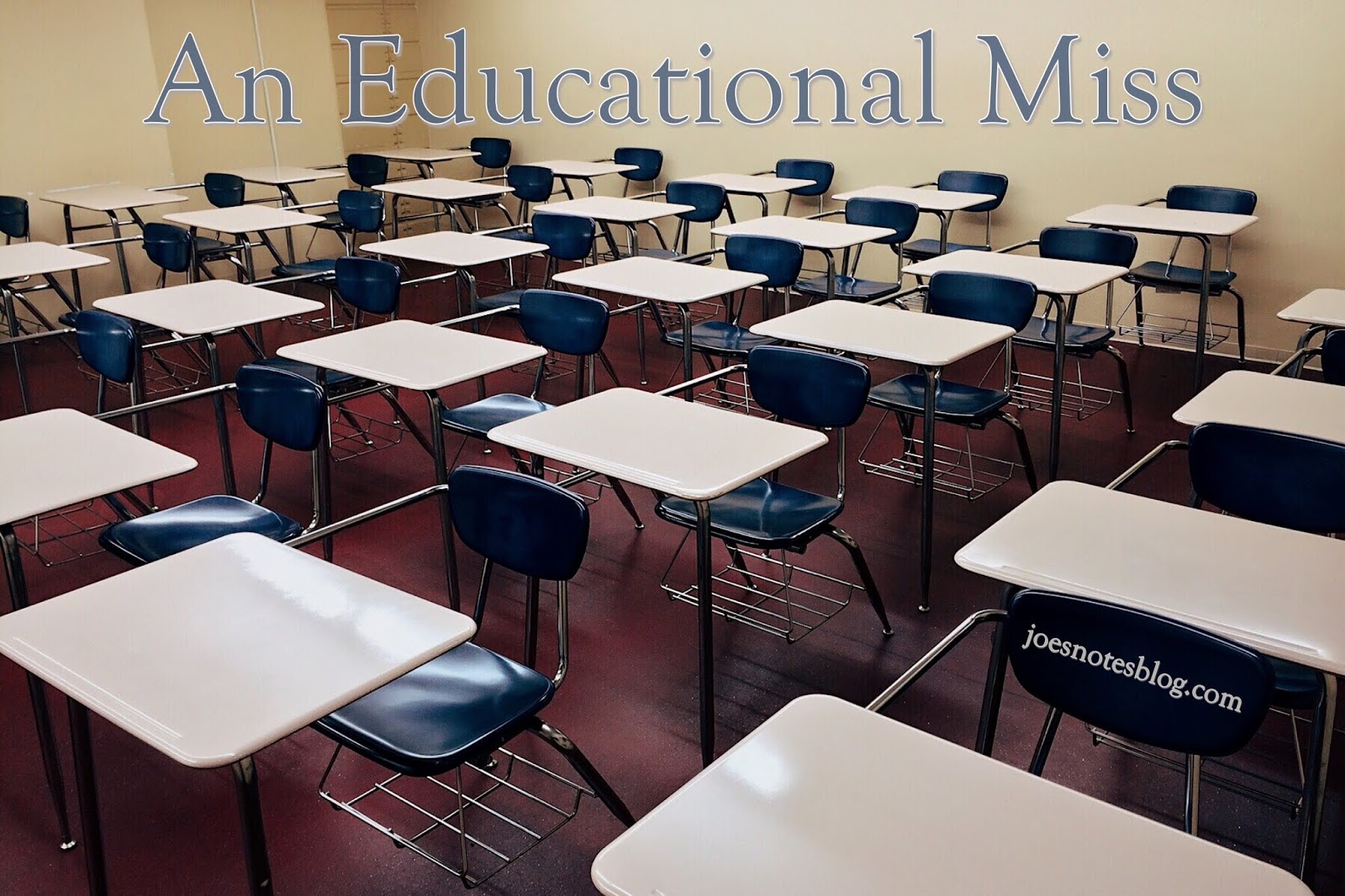
If kids can vote at 18 and everyone thinks they should vote then why is there essentially no formal education related to political philosophy? They should also be practiced in evaluating candidates and understanding the process and its consequences.

There seems to be a gap between whose role it is to teach life skills and job skills. Formal education was originally a supplemental experience that would prepare one with a means to know how to do something valuable. Something that would ensure they get a skill-based job. I'm sure that it all originated with apprenticeships and other on the job training and then, in time, turned into more and more of an institutionally based endeavor. Education, it seems, has become bastardized by laziness, bureaucracy,  and politics. (Yet another example of how the government corrupts a good idea.)

More and more people started sending their children to school. This allowed them to get a head start on reading, writing, and math, which was becoming more and more of a necessity in industrialized nations. As occupations went away from farming, parents spent less and less time at home and needed somewhere for their children to be during the day. Soon, and with the help of the efficiency born of the factory, schools started taking up more and more of the role that parents once held.

Life skills were traditionally taught by parents by both modeling and direct teaching. Parents would teach their children about household duties, sex, religion, politics, and all the things that are involved in navigating once's culture. It was the role of the parent to truly prepare their children for the outside world and it was the role of the school to prepare their mind for fundamental cognitive abilities that would become financially viable.

Throughout much of American history, mothers stayed home and took care of household maintenance and fathers went off to work somewhere for most of the day. As women started joining the workforce and the government decreased the value of money through inflation in an effort to increase tax revenue children became more and more neglected. Now we have a situation where the vast majority of citizens live in the working class, which means that they typically need a two household income in order to pay bills. This means that there is less time to teach their children life skills and with schools teaching nearly everything under the sun, parents don't know what their children are missing. Also, because they were never formally taught modern life skills they assume that their children will learn as they did, just by doing it.

I think that we would all be better off defining the roles of both parents and educational systems. I think that the government's "free" schools should either provide life skills or not. If they are going to take on the role of educating the youth to create effective, successful and productive adults then they should teach the things necessary to accomplish this. This includes teaching skills such as sex education, finances, political philosophy, cooking, health, computers, typing, etc. If this was the case then this would be on the top of the goals list of teaching children job skills as well, such as math, science, geography, English and the like. This is a lot of work for the government and it seems that they are already in charge of much of this and yet don't seem to have a clear goal in mind. If you are going to take on the task of educating the future entirely then you should do it well.

If the government is not the right choice for the job of educating children in life skills then it would fall to either the parents or a private agency such as a private school. The nuclear family seems to be falling apart and one thing that is helpful about the nuclear family is it relieves the parents of some of the burden and allows for a more stable, nurturing and ultimately healthy environment for the development of a child's capacities. As single-parent households rise parents are more stressed, less attentive and more absent in their children's lives, leaving less room to teach life skills. Also, because the parent is struggling it does not provide a hopeful example for the child either. Why would a child listen to the advice of someone who is barely making it? They won't. They will go somewhere else.

Where do children go to learn life skills? Now, it's the internet. If they want to learn about sex they look it up online. Not just porn but articles about how to be in relationships. Or they just watch porn. Only the more intelligent look deeply into their own potential and seek out experts. Many just do as others do and will end up just like their parents even though they despise them. They look to celebrities and emulate their personalities in a naive attempt to become someone important instead of becoming themselves.

The world is becoming more and more complicated and young people have more possibilities ahead of them than ever. Even if parents take the time to teach their children they are most likely unaware of the current considerations that young people should be made aware of. Every year there are new technologies, industries, laws, and cultural mores that parents can't keep up with and therefore cannot educate their children in a way that will be relevant for them in the future. The government takes so long to update their curriculum and continually changes their standards that they cannot educate the youth in a way that prepares them for our complex and rapidly changing world. It makes sense that so many young adults (and many not so young adults) find themselves scrambling to understand the world that they are thrust into when they turn 18.

Waiting for people to "figure it out" on their own is terribly inefficient and wastes so much potential. Well before someone graduates, they should be immersed in the real economic world. Diverse and extensive job experiences before the age of 18 would help transition the young into the world that they are already a part of but are separated from partly out of necessity and partly out of fear. People learn from doing and so if you want people to understand the world they must experience it. For children, this is facilitated by adults and for teens, mentors can help transition them into the world. If parents don't take the time to mentor and educate their children then there will exist a gap between the real world and the insulated world of children. On the other hand, some children are thrust into the real world too early and are forced to engage in adult activities before they understand them.

Maybe companies like Youtube, Kahn Academy, Udemy and others will bridge the gap that exists but children don't know what they don't know and if they don't actively engage in educating themselves then they will go through the growing pains that most of us deal with when we have to fend for ourselves. While people make due and some will be very successful and some will fail miserably with the majority somewhere in between the world could be improved by taking education more seriously, not for the sake of the state but for the sake of humanity and freedom.


Friday, July 27, 2018

You're Not In Control

The modern world is full of communication channels and with everyone expressing their opinions it seems that everyone knows best. Along with their criticisms comes their prescriptions for others. So much of the internet is just people telling other people how to think, how to live and how to vote and I find it to be overwhelming pretentious, self-righteous and annoying.

I'm not sure why everyone wants to control everyone else. Ok, that's not true. I get that everyone is power hungry but why are they so confident? They speak with such certainty and aggression it is as if they think that if everyone just did as they said the world would be perfect. This sounds like an overbearing parent to me. Maybe those who demand subjugation are reenacting their perception of moral nurturing. In demanding others adhere to their ethical framework they are telling others they care and want the world to be better but since their only model for teaching such methods is through demands they bark orders instead of negotiating toward a solution.

This applies more obviously to those that lobby the state to enact their brand of justice. Many hold the government as the ultimate in paternal enforcement and moral justice and it is reasonable to think this way as the government does have the power to take, punish and demand but for those that do not accept that these means are justified, the government is merely a group of control freaks trying to tell us what to do. What is curious is how everyone seems to think that they are in control of others and while many comply with the will of others it is not because the demander is in control.

I think we are only as free as our ability to choose but we are not infinitely free. Nor are we infinitely oppressed. We long for freedom and find those that impede it an enemy. It seems that given enough time humans tend to rebel and fight oppression. I suppose that those that wish to fight the power structure require the means to fight and the alternative has to be worse than fighting so some choose comfort and stability over revolt. This seems true in North Korea, although I am not sure if a significant proportion of their population actually believes they are being oppressed. They might be brainwashed into thinking they are free or at least protected, loved or otherwise part of a meaningful group.

But if the people of North Korea decided to band together and fight their "Great Leader", Kim Jong Un would find that he is not in control anymore. And if someone from inside his own party decided to assassinate him he would find that he is not in control. If he were to get cancer and die he would find that he is not in control. We are not in control of much it seems.

We humans can barely take credit for controlling ourselves but somehow so many think they deserve to control others. We should not be so quick to offer our cure for the world's troubles. Instead, we should focus on our immediate environment, make that better and then work outward. This does not mean we should not act to help others or create change but it does mean we should not be attempting to control others through megalomaniacal demands, force, or shame. We should be humble and honest about our lack of understanding about humanity and about what is best.

I would prefer to think of the Freedom From perspective. This means that I want to be free from others' oppression and impediments. Freedom of association and participation means not being forced to be on someone's team or contribute to someone else's notion of morality. Freedom from laws that force me to go against my beliefs about what is right and wrong. It also means taking responsibility to deal with the consequences of my associations and actions that affect others. I don't believe we should be seeking Freedoms To do whatever it is we want or make others act in a way we want.

I realize that I am prescribing what people "should" do in this while criticising those who do the same but I think that what I want to do is highlight the difference between trying to influence thought and trying to control behavior. Those who try the quick route of influence via force and coercion are adding tyranny to the world while those that use words and ideas to influence are introducing alternatives that can be disregarded or adopted based on its value and accuracy.

Friday, June 23, 2017

Too Abstract

Sometimes people speak too abstractly and lose something in the translation. Such as when a headline says, "Wrestling still isn't sure what to do with women..." What they really mean is that women do not occupy a major role in the wresting industry. "Wresting" isn't a thing that can do things to women. People personify concepts such as "wresting" and give it agency. This is partly in an attempt to understand it better and creates a subject in which to assign blame. You can't understand something better by defining it incorrectly and to blame a concept incapable of physical action is irrational.

Another example of this is when someone says "we" when referring to all people. Someone may say, "We are all just animals," or, "We all want happiness," or, "We are fundamentally good," what they are doing is abstracting their own concept of who they are and projecting it onto the world of people. In many cases it would be more accurate to say "I" in these circumstances. (One can make accurate generalizations about all humans but they have to be based on some evidence and not just an assertion about the nature of humanity.) Also, I used absolute examples here, which is another example of people not using precise language. Absolutes are rarely accurate.

When people use idioms and cliches too much they are also utilizing abstraction to a degree that can lead to a lack of precise thinking and communicating. Prescribed phrases such as, "Obviously" or, "Don't cry over spilt milk", allow people to blurt out what seems like the right thing to say but is really just an automatic response indicating a lack of contemplation and autonomy. (More examples of idioms: http://www.smart-words.org/quotes-sayings/idioms-meaning.html)

“The great enemy of clear language is insincerity. When there is a gap between one’s real and one’s declared aims, one turns as it were instinctively to long words and exhausted idioms, like a cuttlefish spurting out ink.”
George Orwell, Politics and the English Language

I try to listen for people blathering and I wonder whether they know just what they have said. 

The art of bullshitting becomes a fast friend to those that find it difficult to admit that they don't know something. Abstraction makes this easier as well. Saying vague things like, "Boys will be boys," or, "it is was it is," one can hide in the abstract instead of the concrete and plain. 

Try to use your own words and think about what it is you're actually trying to communicate. It isn't always necessary to create an elaborate metaphor or use a pithy phrase. Sometimes, "I'm hungry," or,"I'm sad" are more effective than, "I could eat a horse" or, "It is what it is." 

Metaphors can be very powerful tools for communication so sometimes they are highly effective and aid the speaker in relating a concept to their audience and I have used plenty of pithy phrases but I think it is important to get out of the automatic response system and search for the right words to express myself as much as possible. It can be clunky at times and awkward pauses are bound to happen but I enjoy the rare occasions where I say exactly what I'm thinking.